

Digital Preservation - the process of keeping electronic material accessible and usable for longer periods of time - has turned into one of the most pressing challenges within the digital library community. Long-term archiving of digital material is a highly complex and diverse matter. This is partially due to rapid changes and ongoing developments in file formats. At the same time, hardware and information technology infrastructure are subject to constant changes, making the task even more difficult.
A wide variety of institutions and individuals from countless fields have a strong interest in keeping their digital objects accessible and usable over the next decades. Libraries and museums are increasingly digitising their holdings or even holding born-digital content. Insurance companies, the car and aviation industries as well as pharmaceutical companies and others have a strong interest in preserving their data holdings, simulation models, or studies over time. Private users who want to keep their photo, audio, or video collections accessible are a prime target audience. Some institutions may even be required to keep copies of their documents due to legal constraints. For others, providing digital content is a central part of their business model. Basically, an enormous range of material is worth being preserved for different purposes, leading to vast numbers of differing preservation requirements.
Research in Digital Preservation tackles these challenges by addressing the whole life cycle of digital objects as well as their surrounding organizational and technical environment.
Contact: Andreas Rauber
Software Tools for Business & e-Science Processes
A set of tools and services that supports the management of processes and its execution environment. We offer tools helping to model and specify processes by describing its execution context. We further provide services to analyses of processes and provides recommendation for alternative implementations.
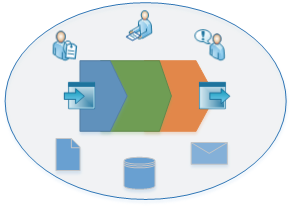
The Process Migration Framework provides model-based migration of processes from shared environments to dedicated virtual machines. A framework for analyzing and evaluating software implementations for Escrow is available.
Content Profiling
Content profiling provides insights into the content of a digital collection. It provides an in-depth view of data to preserve and is the basis for risk analysis and preservation planning.
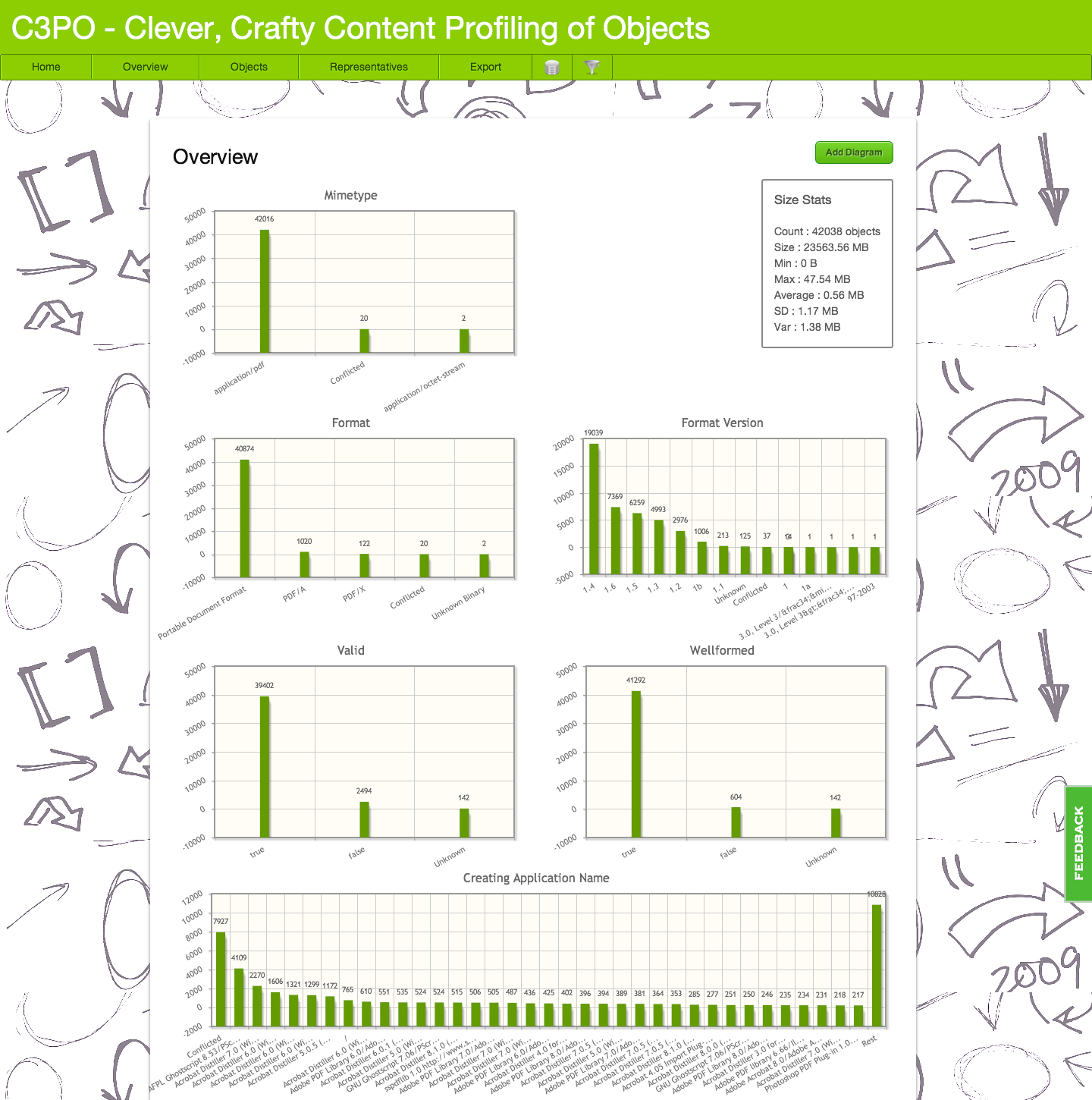
We are working on the challenges that the large amount of data poses for content holders in characterisation, aggregation and analysis of the metadata of digital collections.
Escrow
Escrow is needed for programs that are essential for the business of a software consumer. There is a necessity to preserve the source code and all relevant artifacts of the software in order to release everything needed to maintain the software once the developer is not available anymore, because he files for bankruptcy for instance.

To support a reviewer in evaluating the artifacts put into escrow, we developed a framework based on Sonar that checks the input and outputs a report on artifacts that are not suited for preservation or that need to be evaluated manually.
DME
The Austrian Research Studio Digital Memory Engineering conducts industry-oriented research and development in the field of digital preservation. The aim of the DME is the development of preservation solutions for the industry with a special focus on SMEs.
The main focus was on a new approach to (semi-)automate digital preservation system that are suited to the needs with limited expertise in data management and preservation. Hoppla archiving system combines back-up and fully automated migration services for data collections in small institution settings.
Recovering Digital Objects from Analogue Audio Waveforms
Specimens of early computer systems stop to work every day. It becomes necessary to prepare ourselves for the future situation of having storage media and no working systems to read data from these carriers. With storage media residing in archives for already obsolete systems it is necessary to extract the data from these media once it surfaces before it can be migrated for long term preservation.

The tool presented on allows us to extract data created on one of these early home computer system.
[more]Timecapsule
With the transition from paper to electronic, the volume of digital information we create, store and need to hold onto has exploded. On 18 May 2010, the Planets (Preservation and Long-term Access through Networked Services) Project deposited the Planets TimeCapsule in the vaults of datacenter, Swiss Fort Knox, in Saanen, Switzerland.
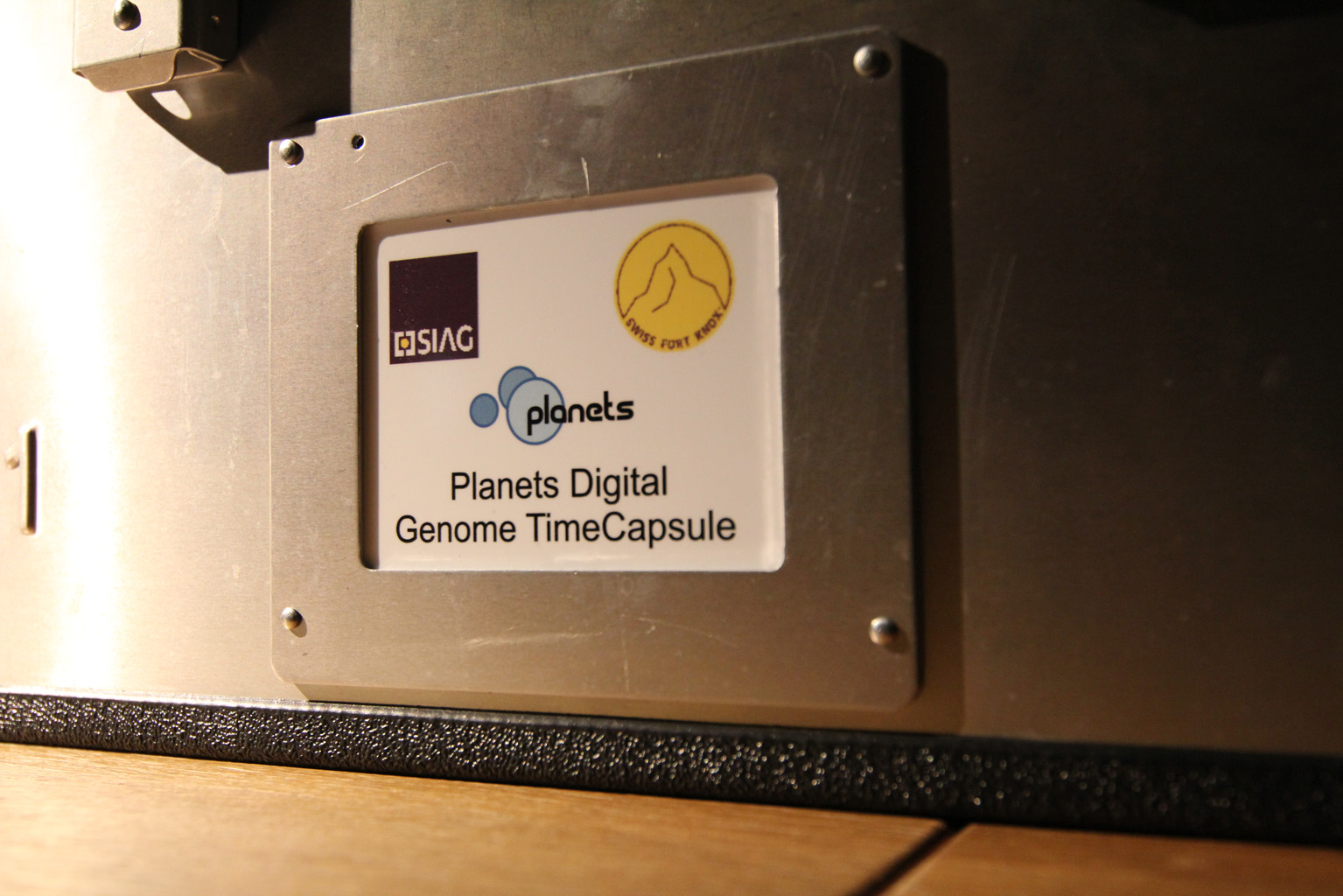
The data will be stored securely for years to come. Without intervention, however, our ability to access its contents will, over time, be lost.
Arbeitskreis Langzeitarchivierung
Working Committee on Digital Preservation in Austria
Project Members: Andreas Rauber, Christoph Becker, Stephan Strodl, Robert Neumayer, Hannes Kulovits
Summer Schools and seminars
In the course of our work in the Digital Preservation Cluster of the DELOS Network of Excellence on Digital Libraries and the projects PLANETS and DPE, we are also involved in a series of summer schools, seminars and training events on Digital Preservation.
IWAW
International Web Archiving Workshops are held in association with the European Conferences on Digital Libraries (ECDL) since 2001. The aim of these workshops is to bring together researchers, practitioners, graduate students and IT developers with expertise and interest in building web archives. These workshops provide a forum for interaction among librarians, archivists, academic researchers and industrial researchers interested in establishing effective methods and developing improved solution for web archiving.
Organizing Committee member: Andreas Rauber
Benchmarking
Current theoretical frameworks, engineering approaches and technologies in ICT are not sufficiently capable of efficiently and effectively sustaining the authenticity, understandability and usability of digitally encoded information over time.
Benchmark DP is developing the first coherent, systematic approach to assess and compare digital preservation processes, systems, and organizational capabilities.
Monitoring
Digital preservation deals with an ever-changing technological environment as well as changes in policies surrounding digital collections. These changes present both preservation risks and opporunities for content holders.

Our work focuses on providing and ontological knowledge base to describe the environment collections and content holding organisations reside in as well as monitoring changes in the environment.
Data Citation and Reproducible Research
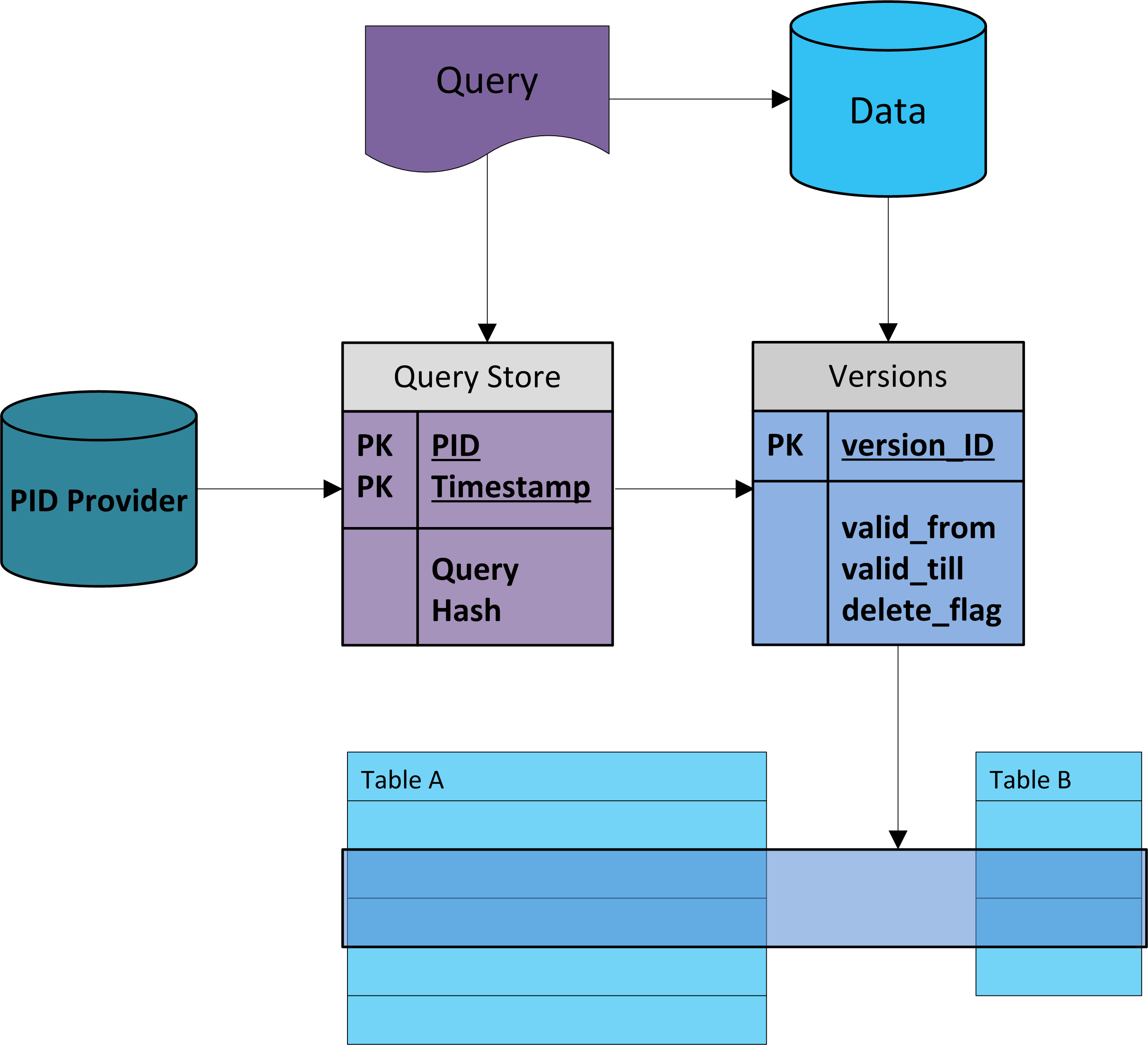
Reproducible research is a fundamental principle of scientific work as it allows to verify results. Therefore data citation is an important instrument that enables referencing, reusing and citing data sets that have been generated and used during experiments.
DPE
DPE Coordinated Action (FP6) facilitates pooling of the complementary expertise that exists across the academic research, cultural, public administration and industry sectors in Europe. DPE fosters collaboration and synergies between many existing national and international initiatives across the European Research Area.
O2EM
Emulation is one of the main strategies for preserving digital objects. This creates the necessity to evaluate the results of digital preservation actions involving emulators, to make sure that renderings of digital objects stay true to the original once they are replayed at a later point in time.
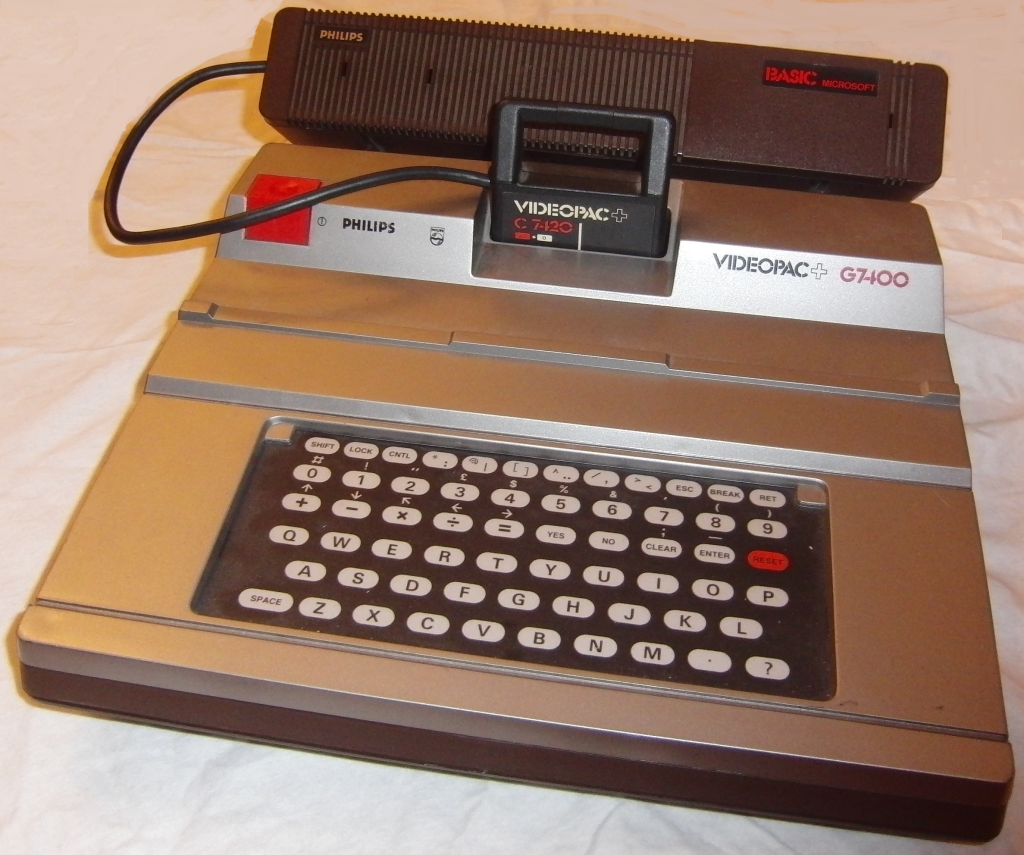
Most emulators today do not support extracting information about the rendering nor feeding data into the environment at certain points in the rendering. To evaluate how this could be implemented in complex rendering environments, we took an emulator for a rather simple homecomputer system and extended it with features necessary for evaluation.
Migration of WARC Content
Internet archives are crawling, storing and managing enormous large collections of Internet content. While this is a complex task itself, the Internet archives are facing a new emerging challenge concerning objects in outdated formats.
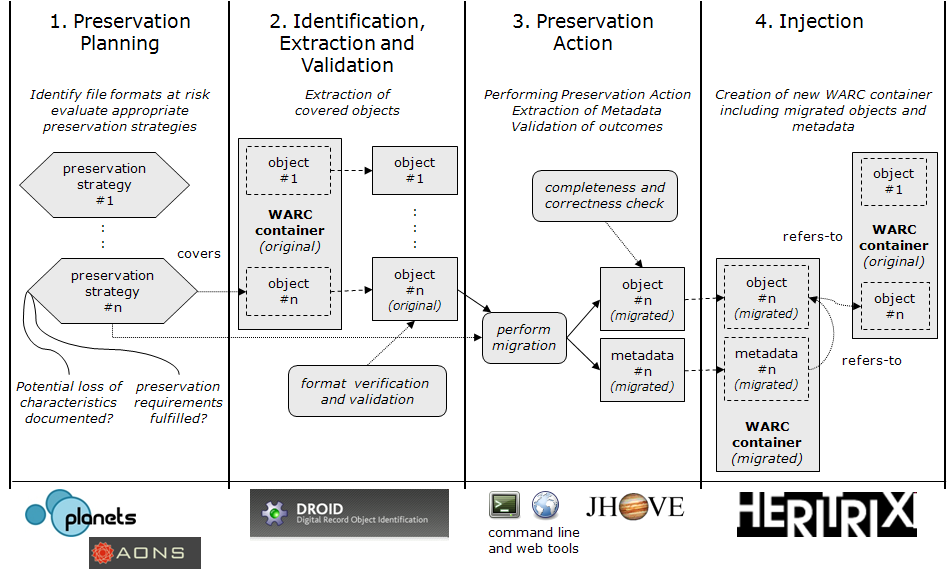
We developed a preservation workflow to migrate the content of WARC archives. A set of tools was developed to support the workflow including identification, extraction and verification of objects.
Documenting Virtual Worlds
We describe approaches to the challenges of archiving virtual worlds, approaches that focus on a natural documentation technique to produce information that is similar to modern TV and picture documentary products.

Wissensnetzwerk Digitale Langzeitarchivierung
Mitglied des österreichischen Wissensnetzwerk Digitale Langzeitarchivierung (Dig:LA) unter der Koordination des österreichischen Bundesklanzleramtes, des österreichischen Staatsarchivs sowie der österreichischen Nationalbibliothek
Project Members: Andreas Rauber, Christoph Becker, Stephan Strodl, Robert Neumayer, Hannes Kulovits
PDF-Security (2005)
The new PDF standard supports various ways of electronic signatures. Goal of this project is a feasability study addressing issues of electronic signatures in PDF documents and their suitability for a range of applications in the e-government domain within the context of par.19 of the eGovernment law.
Project Members: Andreas Rauber
Planning
Digital preservation requires preservation actions to be carried out when the original environment of digital objects is unavailable. A variety of preservation actions exist, but each shows specific peculiarities, and a variety of factors influence the decision.
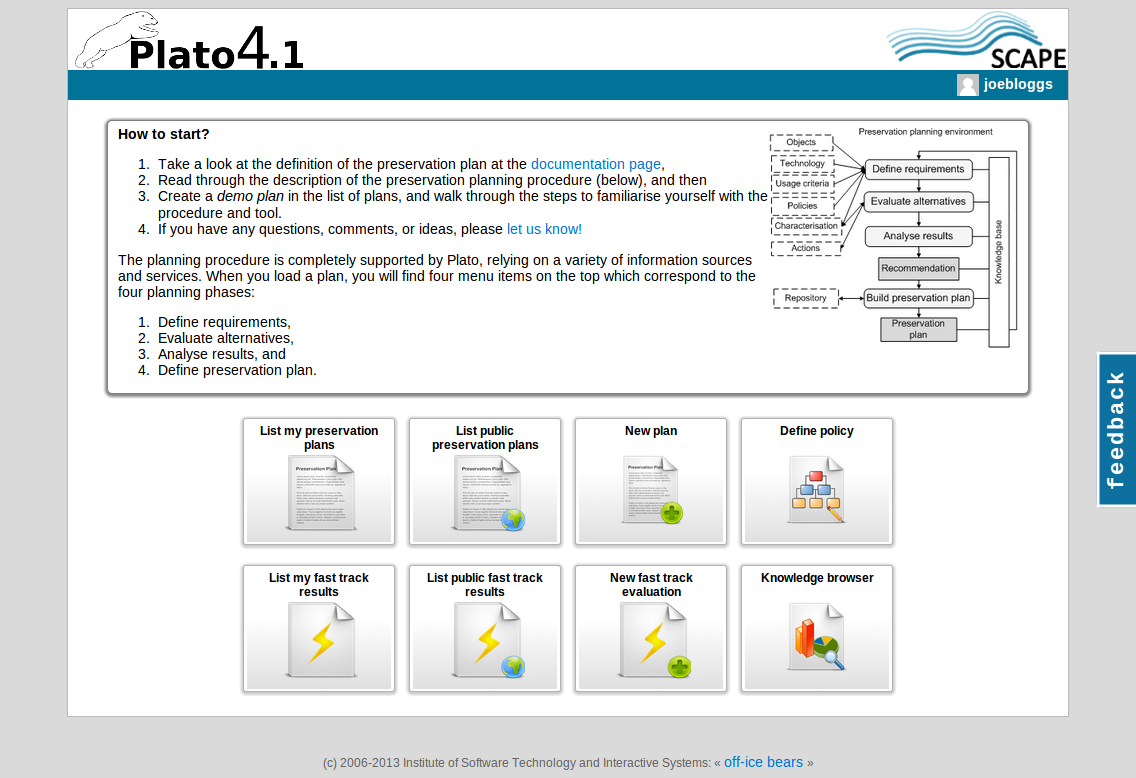
Preservation planning ensures authentic future access by defining these actions. We are working on a decision support tool that implements a solid preservation planning process and integrates services for content characterisation, preservation action and automatic object comparison in a service-oriented architecture to provide maximum support for preservation planning endeavours.
Process Management Plans
The reproducibility of research and possibility of reliable verification of results are key assumptions of credible data-driven science. The preservability of research can be improved by Process Management Plans, which are a novel process-centric approach to data management.

We are currently working on automation of PMP creation and verification by extraction of process characteristics automatically from its environment. Specific focus is on tool support to automate many of the various documentation steps, specifically capturing and monitoring of low-level process characteristics and performance aspects.
Hoppla
Small institutions are often hardly aware of changes in their technological environment. This can have serious effects on their long-term ability to access and use their highly valuable digital assets.

With Hoppla, we are developing a solution that combines back-up and fully automated migration services for data collections in small institutions and small and home offices. The system builds on a service model similar to current firewall and antivirus software packages, providing user-friendly handling of services and an automated update service, and hiding the technical complexity of the software.
DELOS NoE Digital Preservation Testbed
DELOS Digital Preservation Testbed provides an approach to make informed and accountable decisions on which preservation solution to implement in order to preserve digital objects for a given purpose.

DPT allows to specify and document digtial preservation requirements and goals and supports an appropriate documentation of the process, experiment and evaluations. It is based on Utility Analysis to evaluate the performance of various solutions against well-defined objectives, and facilitates repeatable experiments in a standardized laboratory setting.
iPRES 2010
The Vienna University of Technology is pleased to co-host the International Conference on Preservation of Digital Objects (iPRES 2010).
iPRES 2010 re-emphasises that preserving our scientific and cultural digital heritage requires integration of activities and research across institutional and disciplinary boundaries to adequately address the challenges in digital preservation.
Langfristige Archivierung digitaler Fotografien
A study was conducted on the problems and challenges of long-term archiving of digital photographs.

Nestor Kompetenznetzwerk Langzeitarchivierung
Mitglied im Nestor Kompetenznetzwerk Langzeitarchivierung, mit Kooperationen im Schwerpunkt Qualifizierung und Ausbildung.
Project Members: Andreas Rauber, Christoph Becker, Stephan Strodl, Robert Neumayer, Hannes Kulovits
AOLA
The need for creating an archive of the information published on the Web, being part of humankind's cultural heritage, is being recognised by national libraries worldwide, and resulted in the creation of numerous projects addressing these issues.

The goal of this project is to build an archive of the Austrian Webspace. Documents will be harvested at certain time intervals to produce snapshots of the Austrian Webspace.